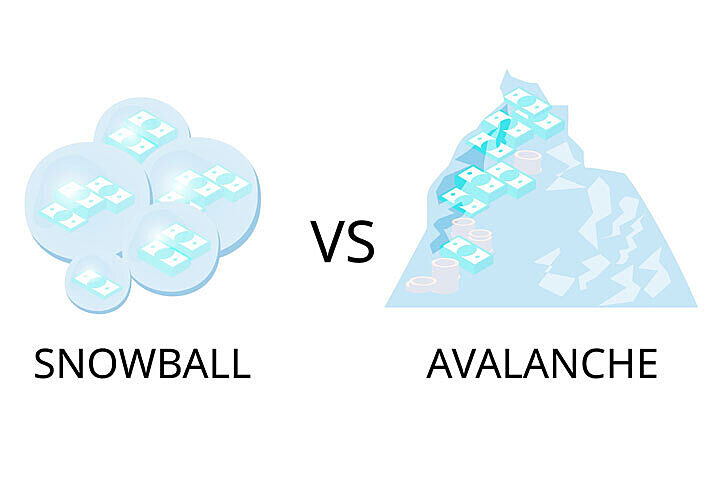
Deconstructing the Debt Snowball
Americans are swimming – make that drowning – in credit card debt. If you are carrying a balance from month to month, you are likely accruing even more debt, perhaps at a sizable rate. How do you break the debt cycle and pay off your credit cards? There are two main strategies to help people get out from under high-interest debt and wipe away the mountain of stress that carrying such a financial load can bring.
The Snowball Method
First up is what’s known as the debt snowball method.
This involves taking a look at all of your credit card balances to see which one is the smallest. Once you identify the lowest balance, pay as much as you can on that card every month – while still making the minimum payment on your other cards – to clear the debt completely. Once the card with the lowest balance has been paid off, tuck it in a drawer and begin to throw more money at the next smallest balance until it’s paid off. Continue down this path until all of your balances have been wiped out.
The idea with the snowball method is that often people need to see progress pretty quickly to maintain momentum and continue paying off their credit card balances. A 2016 study published in the “Journal of Consumer Research” backs this up. Three experiments were conducted among people who carried balances across multiple credit cards. The results showed that concentrated “repayment strategies tend to boost consumers’ motivation to become debt free, leading them to repay their debts more aggressively,” according to the research. “This motivating effect is most pronounced when the repayments are concentrated into consumers’ smallest accounts because (people) tend to infer overall progress in debt repayment from the greatest proportional balance reduction within any one account.”
Unfortunately, the snowball method can cost more because you don’t take into consideration how high the interest rate is on the debt you pay down first.
The Avalanche Method
That’s where the avalanche method comes in. For this debt repayment plan, you place the bulk of your efforts on the credit card with the highest interest rate, while still paying the minimum on everything else. You work to pay off the highest interest rate card first because that’s the one that costs the most money. By simply switching the order in which you pay off your debts – you can save thousands depending on what you owe.
How About a Hybrid?
There is also a way to combine the debt paydown methods to work in your favor. If you are convinced that paying off a small balance in full will give you the jolt you need to keep at it, go for it. Then, once that first credit card is paid off, tackle the card with the highest interest rate. You’ll be glad you did.
Article distributed in partnership with SavvyMoney with reporting by Casandra Andrews and Jean Chatzky